

Author: Dr. Trevor Kouritzin
Dr. Trevor Kouritzin holds a Doctorate in Medicine, a Master’s degree in Human Nutrition, and a Bachelor’s degree in Chemical Engineering. During his academic career, Trevor actively pursued competitive bodybuilding, ultimately earning a pro card, while also participating in various team sports. He is deeply passionate about the clinical and therapeutic applications of dietary supplements for enhancing health, performance, and overall quality of life.
Yes, you can mix creatine with protein powder. Creatine monohydrate can go straight into a whey protein shake, and combining them is safe and convenient. Mixing creatine with protein powder is generally safe and effective, and there is no evidence of a harmful interaction between the two.
Creatine and protein play different roles in your body. Creatine supports energy production during high intensity exercise by regenerating adenosine triphosphate (ATP)1. Protein supplies amino acids, including essential amino acids like leucine, that drive muscle protein synthesis and muscle recovery after resistance exercise2. Neither is a substitute for the other; creatine is not a substitute for protein and protein is not a substitute for creatine. What matters most is daily consistency with creatine supplementation (3–5 g per day) and hitting your total protein intake across the day.
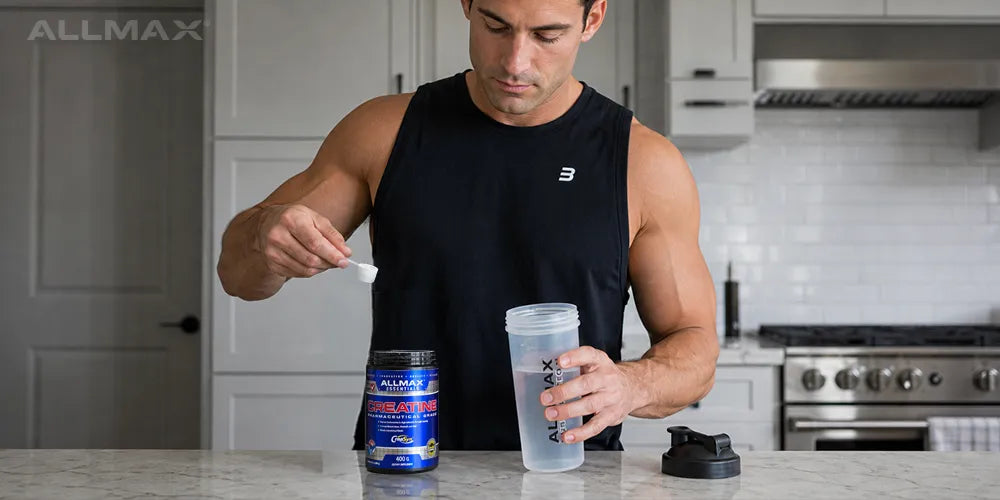
ALLMAX Creatine Monohydrate Powder delivers 5 g of pharmaceutical-grade CreaSyn™ creatine per scoop, unflavored and micronized for easy mixing. ALLMAX Isoflex Whey Protein Isolate provides 27 g protein per 30 g scoop, with only 120 calories and zero sugar. The new ALLMAX Creatine + Isoflex bundle packages both together for a streamlined daily routine.
Can You Mix Creatine With Protein Powder?
Mixing creatine and protein powder is safe, common, and primarily a convenience choice. There is no evidence of harmful interaction between creatine monohydrate and whey protein powder when used at recommended dosages. The combination simply lets you take both supplements in one step.
Creatine monohydrate is typically mixed with water, juice, or other liquids. Adding creatine to a protein shake works just as well. Consuming creatine in a whey protein isolate shake does not reduce creatine's effectiveness or change how your body processes it. There is no strong data showing that separating creatine from protein produces better results than combining protein and creatine in the same glass.
ALLMAX Creatine Monohydrate is unflavored and micronized (200-mesh), so it disperses easily into an Isoflex shake without changing the taste or texture. For creatine, hitting ~3–5 g per day consistently is more important than whether you mix creatine with protein or drink it alone.
Safe to mix in the same shake
Convenient for daily supplement intake
No established extra benefit from separating them

What Happens When You Mix Creatine and Protein Powder?
Mixing creatine and protein doesn't create a new compound. Each works through its own mechanism, and combining protein and creatine in one shake simply means both get to work once absorbed.
What Creatine Does
Creatine is a naturally occurring compound stored mostly in muscle tissue as phosphocreatine3. During short, intense efforts like heavy sets or sprints, phosphocreatine rapidly donates a phosphate group to regenerate ATP. Creatine helps regenerate ATP during short, high-intensity efforts, which is why creatine supplements have become one of the most studied ergogenic aids in sports nutrition4.
Creatine monohydrate has been studied in over 1,000 trials, and has been shown to increase muscle creatine and phosphocreatine stores by 20–40%1. This translates to measurable improvements in muscle strength, power output, and exercise capacity during high intensity workouts5. Creatine enhances strength and power output during workouts and can enhance muscle mass and strength over time when paired with resistance training6.
Creatine also draws water into muscle cells, increasing intracellular volume. This cell swelling may itself act as an anabolic signal7. Supplementing with creatine can increase muscle mass over time, and some research shows creatine can reduce muscle damage and inflammation post-exercise, supporting faster recovery between intense training sessions8. These benefits come from reaching and maintaining saturation through consistent daily dosing, not from mixing creatine with any specific beverage. ALLMAX Creatine Monohydrate uses pharmaceutical-grade CreaSyn™ creatine, micronized for solubility, and is designed for daily use including on rest days.
What Whey Protein Does
Whey protein is a high-quality, complete protein rich in essential amino acids. Leucine content is particularly high in whey protein isolate (roughly 2–3 g per serving), and leucine is the primary amino acid that triggers the mTOR pathway to boost muscle protein synthesis after resistance exercise9. Protein powder supports muscle repair and growth after exercise and is ideal for post workout recovery.
ALLMAX Isoflex is ~90% protein (27 g protein per 30 g scoop) with very low carbohydrate and fat content. Protein powder provides a convenient source of protein for busy lifestyles and helps increase protein intake without extra calories. Consuming protein powder like Isoflex makes it easier to hit the commonly recommended range of 1.6–2.2 g protein per kg of body weight per day for lifters2.
Adequate total daily protein intake is more influential for muscle growth than chasing a narrow post workout window. Whey protein supports muscle repair, recovery, and maintenance of lean muscle mass, which indirectly improves exercise performance over time. Creatine and protein work in parallel: creatine helps you train harder; protein helps you rebuild and adapt.
Is It Better to Take Creatine With Protein?
Taking creatine with protein is fine and sometimes modestly improves creatine retention, but it is not required for creatine to work.
Research shows that co-ingesting creatine with carbohydrate and/or protein can increase creatine retention via insulin-related mechanisms10. Combining creatine and protein can enhance nutrient uptake through an insulin response. However, long-term strength and hypertrophy outcomes remain similar as long as daily creatine intake is consistent11. Combining creatine and protein may not produce a large additional performance benefit beyond what each delivers individually.
The synergistic effect of combining creatine and protein supports muscle growth and recovery by covering both energy production and structural recovery needs. Combining protein and creatine helps cover energy production and structural recovery in one shake. Mixing supplements into a single shake improves convenience and compliance, which is often the real advantage: many fitness enthusiasts remember their daily creatine better when they always add it to their Isoflex shake.
When Should You Take Creatine and Protein?
Both creatine and protein can be taken pre workout, post workout, or with meals. Timing is flexible as long as daily totals are met. Studies comparing pre- vs. post-workout creatine dosing show small or no meaningful differences for most lifters.
For creatine, daily consistency matters more than specific timing. A clinical trial comparing 5 g creatine before vs. after workouts over 8 weeks found no clear advantage for either approach12. Consume protein powder post workout for optimal recovery, though what matters most is hitting daily protein targets, ideally spread across 3–5 meals with 20–40 g high-quality protein each. Taking creatine after workouts can enhance absorption, but the effect is modest.
Common patterns that work:
Post workout: Isoflex + creatine shake immediately after training
With a meal on rest days: creatine stirred into a morning shake or beverage
Pre workout: creatine with a protein shake 30–60 minutes before lifting
As a snack: an Isoflex shake with creatine to fill a gap between meals
How Much Creatine Should You Add to a Protein Shake?
The recommended dosage for creatine is 3–5 grams daily. One scoop of ALLMAX Creatine Monohydrate provides 5 g, making it simple to add one scoop to your daily protein shake.
For most users, adding creatine to one shake per day is enough to maintain saturated muscle creatine stores. An optional loading phase of ~20 g/day (roughly 0.3 g/kg body weight), divided into 4 doses for 5–7 days, accelerates saturation. Without loading, daily 3–5 g intake reaches full saturation in about 3–4 weeks. Higher doses per serving (above 10 g at once) can increase the likelihood of GI discomfort without improving results.
No loading: 5 g once daily mixed into your protein shake
Loading: 5 g four times per day for 5–7 days, then 5 g daily
Maintenance: 3–5 g daily, indefinitely
How Much Protein Should You Add?
Protein requirements are individual, but many resistance-trained adults see good results around 1.6–2.2 g protein per kg of body weight per day. The ideal protein intake post workout is 20–30 grams of high-quality protein to maximize increased muscle protein synthesis.
One scoop of ALLMAX Isoflex provides 27 g protein, fitting neatly into that per-meal range. Users can adjust to 1–2 scoops depending on their daily macro targets and whether that meal includes other protein-rich foods. Protein powder enhances athletic performance during intense training by ensuring you consume ample protein to support recovery.
80 kg lifter aiming for ~160 g/day: 2 Isoflex shakes (54 g) plus ~106 g from whole food
65 kg recreational gym goer aiming for ~120 g/day: 1 Isoflex shake (27 g) plus ~93 g from meals
Does Creatine With Protein Help Build Muscle?
Creatine and protein together support muscle growth by improving exercise performance (creatine) and supplying amino acids for muscle protein synthesis (protein). Resistance training remains the primary driver of hypertrophy; supplements support that process.
Protein powder can modestly increase muscle size and strength when paired with resistance training. A meta-analysis across 9 RCTs found an effect size of g ≈ 0.30 for gains in fat-free mass when protein was added to resistance training vs. non-protein controls13. Creatine plus resistance training leads to measurable increases in muscle thickness (0.10–0.16 cm across measured sites over 6+ weeks)14. Early gains in fat-free mass often include increased intracellular water in muscle cells, not purely contractile muscle tissue.
Long-term muscle gain depends on consistent training, adequate protein requirements, and sufficient energy levels. The ALLMAX Creatine + Isoflex bundle offers science-backed creatine monohydrate and high-quality whey protein isolate in one convenient package for athletes pursuing increased muscle mass.
Creatine: supports training volume, strength, and exercise capacity
Protein: supplies the amino acids needed for muscle building and the recovery process
Resistance training: the primary stimulus for muscle fiber adaptation
Can Creatine and Protein Help With Fat Loss?
Neither creatine nor protein is a fat burner. They can indirectly support fat-loss efforts by preserving lean muscle mass and supporting training performance during a caloric deficit.
Creatine may slightly increase body weight due to intracellular water in muscle tissue, which can mask fat loss on the scale. Higher protein intake improves satiety, helps maintain muscle mass while dieting, and slightly increases diet-induced thermogenesis. Long-term fat loss comes down to sustained energy balance, i.e. staying in a calorie deficit.
Creatine helps maintain physical strength during calorie restriction
Protein supports muscle recovery and reduces muscle loss while dieting
Body weight changes on the scale may not reflect actual fat changes
Caloric deficit remains the primary driver of fat loss
Will Mixing Creatine With Protein Make You Gain Weight?
Mixing creatine with protein does not inherently cause fat gain. Any weight increase is usually a combination of water inside muscle cells and potential lean mass, not body fat. Some people notice an early increase in scale weight from water retained within muscle when starting creatine, though the amount varies.
Three components of body weight to distinguish:
Fat mass: increases only with a sustained caloric surplus
Lean mass: muscle fibers and other non-fat tissue; grows with training and adequate nutrition
Intracellular water: creatine draws water into muscle cells, which adds scale weight but is not fat
Total calorie intake and training determine whether you gain fat, not whether creatine is mixed with protein powder or taken separately.
Can You Mix Creatine With Isoflex?
Yes. You can mix ALLMAX Creatine Monohydrate Powder directly into an ALLMAX Isoflex Whey Protein Isolate shake. Many customers take both supplements this way every day.
The basic combo: one scoop Isoflex (27 g protein) plus one scoop ALLMAX Creatine Monohydrate (5 g creatine), shaken with 150–240 mL (5–8 oz) of cold water or low-fat milk, depending on your preferred consistency. ALLMAX Creatine is unflavored and micronized, so it doesn't change the taste of Isoflex flavors like Chocolate Peanut Butter, Strawberry, Vanilla, or Cookies & Cream.
ALLMAX Creatine Monohydrate Powder: pharmaceutical-grade CreaSyn™, lab-tested, 200-mesh micronized, daily use
ALLMAX Isoflex Whey Protein Isolate: ~90% protein, low carbs and fats, fast-digesting whey protein isolate
ALLMAX Creatine + Isoflex bundle: purchase both together for a streamlined, science-backed stack
Adjust scoop counts based on your protein and creatine targets while keeping everything in one simple shake.
How to Make a Creatine + Protein Shake
Here is a simple daily shake using Isoflex and ALLMAX Creatine Monohydrate.
Add 250–350 mL cold water or preferred milk alternative to a shaker bottle
Add 1 scoop Isoflex (flavor of choice)
Add 1 scoop ALLMAX Creatine Monohydrate (5 g)
Optional: add ice, oats, banana, or nut butter for extra calories
Shake vigorously for 20–30 seconds until fully mixed
Blending the shake with ice or fruit is purely for taste and texture; it does not increase creatine absorption or make the supplement form more potent. Creatine can also be added to smoothies, intra-workout drinks, or juice if you prefer taking protein and creatine at different times of day.
Creatine + Protein: Common Questions
Can you mix creatine with protein powder?
Yes. Creatine monohydrate can be safely mixed with protein powder in the same shake. The combination is common among athletes and does not reduce the effectiveness of either supplement. Consistent daily creatine intake and adequate overall protein matter more than whether they share a glass.
Can you take creatine and whey protein together?
Creatine and whey protein can be taken together in the same shake or at different times of day with no known negative interactions at recommended doses. Creatine supports high intensity performance while whey protein supports muscle recovery and growth, making them a complementary stack.
Is it better to take creatine before or after protein?
Timing relative to protein is not a major concern. As long as total daily creatine and protein intakes are met, small timing differences have minimal impact. Many people find it easiest to add creatine to a post workout Isoflex shake, but pre workout or with meals also works.
Can you put creatine in a protein shake?
Yes. Adding creatine monohydrate to a whey protein or whey isolate shake is one of the most common ways athletes take creatine daily. Unflavored, micronized creatine like ALLMAX Creatine Monohydrate blends well into flavored Isoflex shakes.
Does protein help creatine absorption?
Some research shows creatine retention can be slightly higher when creatine is taken with carbohydrate and/or protein, likely due to insulin's role in nutrient uptake. Creatine still works without protein present, so this is a potential small bonus, not a requirement.
How much creatine should I put in my protein shake?
Add 3–5 g creatine monohydrate per day. One scoop of ALLMAX Creatine Monohydrate provides 5 g. Higher single doses are usually reserved for short loading phases and can increase digestive discomfort.
Should I take creatine on rest days?
Yes. Taking creatine every day, including rest days, keeps muscle creatine stores elevated and supports ongoing training adaptations. On non-training days, mix creatine into any shake or beverage at the usual daily dose.
Does creatine make you gain fat?
Creatine does not directly cause fat gain. Initial weight increases are due to increased water inside muscles and potentially more lean mass from improved training. Fat gain only occurs if calorie intake exceeds energy expenditure over time.
Can women mix creatine with protein powder?
Women can safely use creatine monohydrate and whey protein in the same way as men, with similar benefits for strength, athletic performance, and lean mass support. Creatine is not a hormone or steroid and does not inherently cause bulky muscle gains. Follow product directions and consult a healthcare practitioner if pregnant, breastfeeding, taking medication, or managing a medical condition.
Can you mix creatine with whey isolate like Isoflex?
Yes. Creatine mixes well with any whey isolate, including ALLMAX Isoflex. The ALLMAX Creatine + Isoflex bundle is built around this practice, offering a simple, evidence-based stack for mixing supplements.
Conclusion: Should You Mix Creatine With Protein Powder?
Yes, you can mix creatine with protein powder, and doing so is a convenient, science-supported way to take two well-researched supplements—whey protein isolate and creatine monohydrate—together. There is no need to separate them, and combining them can simplify your routine.
Creatine monohydrate supports high intensity training performance, increasing exercise capacity and muscle creatine stores
Whey protein isolate supports muscle protein synthesis, the recovery process, and lean muscle mass
Consistent daily creatine and adequate total protein matter more than precise timing or whether they share the same shake
Mixing does not multiply results, but it can improve adherence. Explore ALLMAX Creatine Monohydrate Powder, Isoflex Whey Protein Isolate, and the new Creatine + Isoflex bundle as a practical, lab-tested stack to support your training and nutrition goals.
References:
Kreider RB, Kalman DS, Antonio J, Ziegenfuss TN, Wildman R, Collins R, Candow DG, Kleiner SM, Almada AL, Lopez HL. International Society of Sports Nutrition position stand: safety and efficacy of creatine supplementation in exercise, sport, and medicine. J Int Soc Sports Nutr. 2017 Jun 13;14:18. https://pubmed.ncbi.nlm.nih.gov/28615996/
Jäger R, Kerksick CM, Campbell BI, Cribb PJ, Wells SD, Skwiat TM, Purpura M, Ziegenfuss TN, Ferrando AA, Arent SM, Smith-Ryan AE, Stout JR, Arciero PJ, Ormsbee MJ, Taylor LW, Wilborn CD, Kalman DS, Kreider RB, Willoughby DS, Hoffman JR, Krzykowski JL, Antonio J. International Society of Sports Nutrition Position Stand: protein and exercise. J Int Soc Sports Nutr. 2017 Jun 20;14:20. https://pubmed.ncbi.nlm.nih.gov/28642676/
Cooper R, Naclerio F, Allgrove J, Jimenez A. Creatine supplementation with specific view to exercise/sports performance: an update. J Int Soc Sports Nutr. 2012 Jul 20;9(1):33. https://pubmed.ncbi.nlm.nih.gov/22817979/
Wyss M, Schulze A. Health implications of creatine: can oral creatine supplementation protect against neurological and atherosclerotic disease? Neuroscience. 2002;112(2):243-60. https://pubmed.ncbi.nlm.nih.gov/12044443/
Wax B, Kerksick CM, Jagim AR, Mayo JJ, Lyons BC, Kreider RB. Creatine for Exercise and Sports Performance, with Recovery Considerations for Healthy Populations. Nutrients. 2021 Jun 2;13(6):1915. https://pubmed.ncbi.nlm.nih.gov/34199588/
Kazeminasab F, Kerchi AB, Sharafifard F, Zarreh M, Forbes SC, Camera DM, Lanhers C, Wong A, Nordvall M, Bagheri R, Dutheil F. The Effects of Creatine Supplementation on Upper- and Lower-Body Strength and Power: A Systematic Review and Meta-Analysis. Nutrients. 2025 Aug 25;17(17):2748. https://pubmed.ncbi.nlm.nih.gov/40944139/
Wax B, Kerksick CM, Jagim AR, Mayo JJ, Lyons BC, Kreider RB. Creatine for Exercise and Sports Performance, with Recovery Considerations for Healthy Populations. Nutrients. 2021 Jun 2;13(6):1915. https://pubmed.ncbi.nlm.nih.gov/34199588/
Izadi, M. A., & Daryanoosh, F. (2025). The effect of creatine supplementation on muscle protein synthesis in athletes: A review. Nutrition Clinique et Métabolisme, 39(4), 273–281. https://doi.org/10.1016/j.nupar.2025.09.001
Moberg M, Apró W, Ekblom B, van Hall G, Holmberg HC, Blomstrand E. Activation of mTORC1 by leucine is potentiated by branched-chain amino acids and even more so by essential amino acids following resistance exercise. Am J Physiol Cell Physiol. 2016 Jun 1;310(11):C874-84. https://pubmed.ncbi.nlm.nih.gov/27053525/
Steenge GR, Simpson EJ, Greenhaff PL. Protein- and carbohydrate-induced augmentation of whole body creatine retention in humans. J Appl Physiol (1985). 2000 Sep;89(3):1165-71. https://pubmed.ncbi.nlm.nih.gov/10956365/
Antonio J, Brown AF, Candow DG, Chilibeck PD, Ellery SJ, Forbes SC, Gualano B, Jagim AR, Kerksick C, Kreider RB, Ostojic SM, Rawson ES, Roberts MD, Roschel H, Smith-Ryan AE, Stout JR, Tarnopolsky MA, VanDusseldorp TA, Willoughby DS, Ziegenfuss TN. Part II. Common questions and misconceptions about creatine supplementation: what does the scientific evidence really show? J Int Soc Sports Nutr. 2025 Dec;22(1):2441760. https://pmc.ncbi.nlm.nih.gov/articles/PMC11703406/
Dinan NE, Hagele AM, Jagim AR, Miller MG, Kerksick CM. Effects of creatine monohydrate timing on resistance training adaptations and body composition after 8 weeks in male and female collegiate athletes. Front Sports Act Living. 2022 Nov 16;4:1033842. https://pubmed.ncbi.nlm.nih.gov/36465581/
Naclerio F, Larumbe-Zabala E. Effects of Whey Protein Alone or as Part of a Multi-ingredient Formulation on Strength, Fat-Free Mass, or Lean Body Mass in Resistance-Trained Individuals: A Meta-analysis. Sports Med. 2016 Jan;46(1):125-137. https://pubmed.ncbi.nlm.nih.gov/26403469/
Burke R, Piñero A, Coleman M, Mohan A, Sapuppo M, Augustin F, Aragon AA, Candow DG, Forbes SC, Swinton P, Schoenfeld BJ. The Effects of Creatine Supplementation Combined with Resistance Training on Regional Measures of Muscle Hypertrophy: A Systematic Review with Meta-Analysis. Nutrients. 2023 Apr 28;15(9):2116. https://pubmed.ncbi.nlm.nih.gov/37432300/