

Anna Kasztenny, MSc.
Anna holds a Master’s degree in Bio-Pharmaceutical Science and Business Studies and a Bachelor of Medical Science with an Honors Specialization in Pharmacology. Alongside her academic background, she is a competitive bodybuilder and strength athlete who holds three provincial powerlifting records. As a former competitive gymnast and varsity cheerleader, she is passionate about health, performance, and evidence-based wellness.
Creatine is one of the most researched sports nutrition supplements available, yet confusion about its role during fat-loss phases persists. If you're asking whether creatine can help with weight loss, the short answer is: not directly, but it can support the process. Here's what the evidence actually shows.
Quick Answer: Does Creatine Help With Weight Loss?
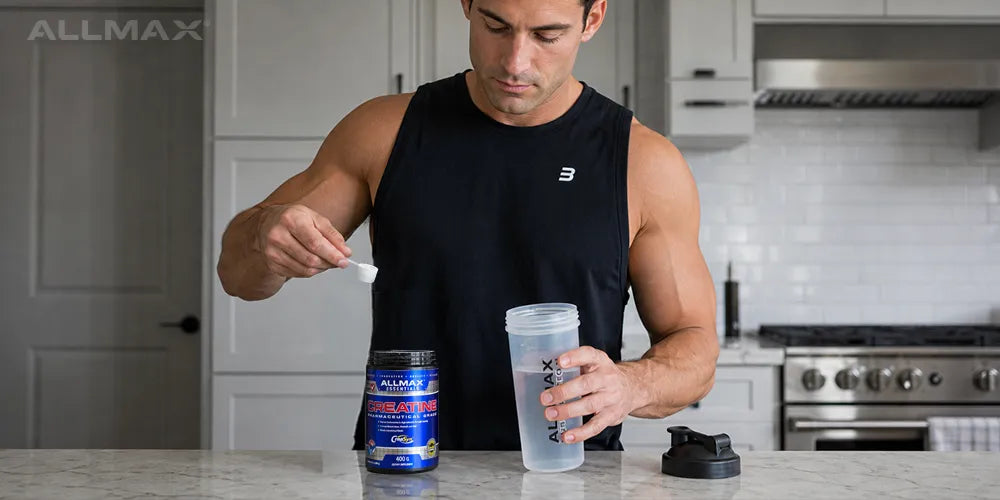
Creatine does not directly cause fat loss. It is not a fat burner, does not increase calorie expenditure, and does not suppress appetite. What creatine does is support high intensity exercise performance, strength, and lean muscle mass retention during a calorie deficit1. This can indirectly improve body composition over time. Creatine may slightly increase scale weight through intracellular water retention in muscle cells, which is not body fat or fat gain2. True fat loss still requires a sustained calorie deficit, adequate protein intake, and consistent resistance training. Creatine can be useful while losing weight or cutting. For those looking for a straightforward creatine powder option, ALLMAX Creatine Monohydrate fits standard dosing protocols without any added fillers or sugar.
What Is Creatine and How Does It Work?
Creatine is a naturally occurring compound found in the body, synthesized from the amino acids arginine, glycine, and methionine, and is stored primarily in skeletal muscle (about 95%) with small amounts in brain tissue supporting cognitive function1. Your body produces roughly 1-2 g of creatine per day, and dietary sources like red meat and fish contribute additional amounts3.
Creatine improves workout performance by enhancing ATP regeneration. Muscle cells store creatine as phosphocreatine, which donates a phosphate group to regenerate ATP during short, intense efforts like lifting weights, sprinting, or jumping4. Supplementing with creatine monohydrate raises these stores beyond what diet alone provides, increasing the phosphocreatine reserve available for high-intensity work. This is the primary mechanism behind creatine's effects on physical performance. Emerging research also explores creatine's potential roles in brain health (including cerebral high energy phosphates) and bone health, though these areas are not directly tied to weight loss5.
What Is the Difference Between Weight Loss and Fat Loss?
Weight loss is any reduction in total body weight. Fat loss is a reduction specifically in body fat. These are not the same thing.
Body weight includes fat mass, muscle mass, water, glycogen, bone, and food in the digestive tract. Someone can lose fat while the scale stays flat if they're simultaneously gaining lean mass or retaining water from creatine supplementation. Initially, weight changes on the scale may not reflect actual fat loss due to water retention from creatine. Daily scale weight fluctuates with sodium, hydration, glycogen, menstrual cycle, and gut content. For people taking creatine supplements during a cut, focusing only on scale weight is misleading. Tracking body composition through measurements, photos, and performance benchmarks gives a clearer picture.

Does Creatine Help With Weight Loss?
Creatine does not directly contribute to weight loss. It does not function as a thermogenic, a stimulant, or a traditional fat burning supplement. It does not increase calorie expenditure or suppress appetite.
Creatine's primary role is increasing muscle phosphocreatine stores, which enhances high-intensity exercise performance. Better training output (more reps, heavier weights, higher intensity) can indirectly support fat loss and improve body composition over weeks and months6. Any fat loss that occurs comes from the overall program: calorie deficit, resistance training, and enough protein. Creatine acts as a support tool within that framework.
How Can Creatine Help When You're Trying to Lose Fat?
While creatine doesn't burn fat, it supports several key components of a successful fat-loss phase.
Creatine enhances high-intensity exercise performance and recovery between workout sets, which matters during a calorie deficit when energy levels and workout performance tend to decline. Maintaining training volume and intensity protects the stimulus your muscles need to avoid atrophy.
Creatine supplementation can lead to greater increases in lean body mass when paired with resistance training. A 2024 meta-analysis of adults under 50 found that adding creatine to resistance training produced approximately 1.14 kg more lean mass and 0.73 kg less fat mass compared with training alone7. That lean muscle is metabolically active tissue, which supports a higher resting metabolic rate over time, though the effect is modest and should not be overstated8.
Creatine improves workout performance, which may lead to better body composition over time. Combined with a structured fat-loss approach, it helps you build muscle or maintain muscle while the calorie deficit handles fat reduction.
Does Creatine Burn Fat or Increase Metabolism?
Creatine does not directly burn fat. It is not a fat burner, thermogenic, stimulant, or weight-loss drug and should not be classified alongside dedicated fat burning supplements.
Human studies consistently show creatine's benefits in strength, power, and lean mass. Direct increases in fat oxidation or resting metabolic rate from creatine alone are not supported by strong evidence. One study found a small increase in carbohydrate oxidation with creatine use, but no meaningful increase in fat oxidation or net energy expenditure9. Animal studies hinting at creatine-driven thermogenesis in beige fat did not replicate in humans10. Creatine is a performance and muscle supplement first.
Does Creatine Make You Gain Weight? (Water Weight vs Fat)
Creatine can cause an initial weight gain from water weight. The amount of water-weight change varies between individuals and depends on baseline stores, dose, diet, and whether a loading phase is used. A 2024 dose-response meta-analysis of 143 trials found an average body mass increase of approximately 1.9 lbs or 0.86 kg with creatine supplementation11.
The mechanism: increased creatine in muscle cells draws water into those cells (intracellular water), but the amount of water-weight change varies between individuals and depends on baseline stores, dose, diet, and whether a loading phase is used2. This is not body fat. Creatine can make muscles appear fuller and more defined rather than bloated.
Users on a loading phase (~20 g/day for 5-7 days) typically see faster scale changes than those using a steady 3-5 g/day. Weight gain from creatine is due to water retention in muscles and does not block fat loss. If you're in a calorie deficit, you can still lose fat even while the scale moves up temporarily.
Why Does Creatine Increase Water Weight?
Creatine supplementation can increase total body water, with much of this change leading to water retention inside muscle cells. When muscle creatine content rises, intracellular osmolarity increases, drawing water into the cell to maintain fluid balance. One 4-week study in active males documented total body water increasing from approximately 53.77 L to 57.15 L during a creatine loading and maintenance protocol12.
This intracellular hydration is different from subcutaneous water (the kind that makes skin look puffy) and from visceral fat around organs. Many people actually look leaner on creatine because of fuller muscles and improved muscle definition. Rapid changes in water weight from creatine, sodium, and glycogen are normal and distinct from changes in body fat.
Can You Take Creatine While Trying to Lose Weight?
Yes. Creatine works during a calorie deficit, at maintenance, or in a surplus because its primary function is in the phosphocreatine energy system, not in energy balance.
Key advantages during a cut: better workout performance, strength maintenance, and support for lean mass. Creatine does not stop fat loss as long as an appropriate calorie deficit is maintained over time. Physique athletes and serious lifters routinely keep creatine in during cutting phases for these reasons. Weight-class athletes preparing for a weigh-in may manipulate creatine timing strategically, but that's a niche scenario.
Can Creatine Help Preserve Muscle During Weight Loss?
Calorie deficits increase the risk of losing lean mass alongside body fat, especially during aggressive dieting or with low protein intake. Creatine may help support training performance and lean-mass outcomes during a calorie deficit when combined with resistance training, but individual results vary. In a short-term energy restriction trial, resistance-trained men on creatine lost approximately 1.4% of fat-free mass versus 2.4% in the placebo group13.
Creatine maintains strength during weight loss, preventing muscle loss. It supports muscle retention while losing fat, improving body composition. Creatine can improve recovery during calorie deficits, aiding muscle preservation. These effects complement, but do not replace, high protein intake, progressive strength training, and adequate recovery. Some portion of measured "lean mass" increases in studies reflects muscle water and glycogen, not exclusively new contractile tissue.
Can Creatine Help You Lose Belly Fat or Target Specific Fat Areas?
Creatine does not specifically reduce belly fat. Spot reduction through supplementation is not physiologically possible. Abdominal fat, both subcutaneous and visceral, decreases as part of overall fat loss driven by a calorie deficit and increased activity14.
Creatine supports the training side of a fat-loss plan, which may contribute to reducing total body fat over time. Claims that creatine "melts belly fat" have no supporting evidence. Improved body composition (more muscle, less fat) can make the midsection appear leaner even without dramatic changes in scale weight.
Should You Stop Taking Creatine While Cutting?
No. In most cases, you do not need to stop creatine because you're cutting. Stopping leads to a gradual decline in muscle creatine stores over several weeks, a decrease in intracellular water, and a small drop in scale weight. That drop is water, not fat.
The trade-off: you lose performance and muscle-support benefits in exchange for a cosmetic change on the scale. Physique competitors close to stage or athletes close to a weigh-in sometimes cycle creatine, but this is an advanced strategy. Whether to continue creatine during a cut depends on personal training goals, scale-weight preferences, and competition requirements.
Is Creatine Useful for Women Trying to Lose Weight?
Creatine is not only for men or bodybuilders. Research confirms that women respond to creatine with improved strength, power, and lean muscle mass when combined with resistance training15. Women tend to have lower baseline creatine stores and may benefit from supplementation for both performance and body composition16.
A large meta-analysis found that women gained approximately 0.54 kg of lean mass with creatine (compared to 1.20 kg in men), confirming a real but smaller effect. For women focused on losing weight, creatine can support a lean, strong physique by helping maintain muscle while training for lean gains11. Standard creatine doses are safe in healthy women, but follow product directions and consult a healthcare professional before use if pregnant, breastfeeding, managing a medical condition, or taking prescription medication
How Much Creatine Should You Take for Weight Loss (or While Cutting)?
Creatine dosing does not change because you're losing weight. The standard recommended dose is 5 grams per day of creatine monohydrate, taken daily.
An optional creatine loading phase (approximately 20 g/day split into 4 doses for 5-7 days) saturates stores faster but is not required and may increase short-term water weight. Consistent daily intake over weeks matters more than loading for long-term benefits. Loading does not improve fat loss. ALLMAX Creatine Monohydrate provides 5 g per serving, fitting standard dosing without guesswork. Readers with kidney disease or complex medical conditions should consult a healthcare professional before supplementation.
When Should You Take Creatine While Cutting?
There is no special "fat-burning" time to take creatine. The key is maintaining elevated muscle creatine stores through daily use. Creatine should be taken daily, even on rest days. Taking creatine post-workout may improve absorption slightly, especially when consumed with carbohydrates and protein, but the effect is modest17.
Choose a time you can be consistent with: morning shake, creatine post workout, or with an evening meal. Creatine has zero calories, so taking it while fasting does not add energy intake. What drives fat loss is the calorie deficit and training plan; creatine timing affects convenience and possibly small performance nuances.
Is Creatine Monohydrate Good for Weight Loss Compared With Other Forms?
Creatine monohydrate is the most studied and widely recommended form. Virtually all strong evidence on strength, power, and lean-mass support comes from creatine monohydrate, not newer or pricier alternatives. No convincing evidence shows that other forms offer superior fat-loss or weight-loss benefits. ALLMAX Creatine Monohydrate is a creatine monohydrate powder supplement option that aligns with this evidence base. Focus on consistency and program quality rather than chasing different creatine forms for "extra" fat loss.
Why Choose ALLMAX Creatine Monohydrate?
ALLMAX Creatine Monohydrate provides 5 g of CreaSyn™ creatine monohydrate per scoop with zero fillers, sugar, or additives. It is 200-mesh micronized, Verified for Sport, and each lot is tested by an ISO 17025-accredited laboratory for more than 480 WADA analytes.
The 200-mesh micronization helps it dissolve quickly in water or shakes for convenient daily use during any phase, whether you're focused on muscle growth, maintenance, or cutting. Because it contains zero calories, it does not break a metabolic or intermittent fast. The product is a straightforward way to add clinically researched creatine monohydrate to a routine aimed at muscle gain, performance, and improved body composition.
Common Myths About Creatine and Weight Loss
Myth: Creatine burns fat like a fat burner. Creatine does not increase fat burning. It supports training and muscle performance, which can indirectly support fat loss.
Myth: Creatine makes you fat or causes belly fat. Any scale weight increase is primarily intracellular water and lean mass, not body fat.
Myth: You shouldn't take creatine while cutting. Creatine supports muscle and training quality during a calorie deficit. There is no reason to stop.
Myth: Creatine causes massive bloating and puffiness. The water retention is intracellular (inside muscle cells), not subcutaneous. Many users look leaner with fuller muscles and better muscle definition.
Myth: Creatine is only for bulking. Creatine supports resistance-training performance and lean-mass goals during both gaining and fat-loss phases.
How Should You Track Weight Loss While Taking Creatine?
Relying on daily scale weight alone is misleading when creatine, water weight, and muscle gain are all in play.
Use weekly average body weight instead of single daily readings
Track waist circumference and how clothing fits as indicators of fat loss
Take progress photos every 2-4 weeks under consistent conditions
Monitor strength benchmarks (key lifts, reps at given loads)
Consider DEXA scans or body composition assessments for clearer data on fat mass and muscle mass changes
Initial scale weight increases from creatine are normal. Interpret them alongside body composition and performance, not as failed weight loss.
What Does the Research Actually Say About Creatine, Fat Loss, and Body Composition?
Research shows creatine can increase fat-free mass and reduce fat mass when combined with resistance training. A 2024 meta-analysis (143 clinical trials) found creatine supplementation increased fat-free mass by approximately 0.82 kg and decreased body fat percentage by about 0.28% on average11. Studies using maintenance doses above 5 g/day paired with resistance training showed stronger effects.
During calorie restriction, creatine supports lean-mass retention and performance without impairing fat loss. Body composition improvements reflect increased lean mass plus modest fat-mass reductions, not creatine directly burning fat. Evidence for creatine increasing fat oxidation or resting metabolic rate is limited and inconclusive. Creatine works best with a solid strength training plan and controlled nutrition.
Evidence Snapshot: Creatine and Weight Loss Outcomes
Question |
Evidence |
Takeaway |
|---|---|---|
Does creatine directly burn fat? |
Limited / No |
Not a fat burner |
Does creatine support training during a cut? |
Strong |
Supports high-intensity exercise performance |
Does creatine support strength? |
Strong |
Especially with resistance training |
Does creatine support lean mass? |
Strong |
Most consistent with resistance training |
Does creatine increase scale weight? |
Strong |
Intracellular water can increase body weight |
Does creatine weight gain equal fat gain? |
No |
Increased muscle water is not body fat |
Can you take creatine during a calorie deficit? |
Yes |
No reason to avoid it |
Does creatine target belly fat? |
No |
Fat loss cannot be targeted to one region |
Should you stop creatine while cutting? |
No |
Stopping is not necessary for fat loss |
Frequently Asked Questions: Creatine and Weight Loss
Does creatine help with weight loss?
Creatine does not directly cause weight loss. It can support fat loss indirectly by helping maintain training quality, strength, and lean muscle during a calorie deficit.
Does creatine burn fat?
No. Creatine is not a thermogenic or fat burner. Its benefits come from supporting high-intensity exercise and lean mass.
Does creatine make you gain weight?
Creatine typically causes a 2-5 pound weight gain initially from intracellular water in muscles. This is not fat gain.
Can you take creatine while cutting?
Yes. Creatine supports performance and muscle retention during a calorie deficit without blocking fat loss.
How much creatine should I take while losing weight?
The standard dose is 5 grams of creatine monohydrate per day. This does not change during a cut.
Is creatine monohydrate good for weight loss?
Creatine monohydrate is the most researched form and supports performance and lean mass. It is not a weight-loss supplement itself but fits well into a fat-loss program.
Is ALLMAX Creatine Monohydrate good for cutting?
ALLMAX Creatine Monohydrate provides 5 g of 99.9% pure creatine monohydrate per serving with zero calories, making it a practical option during any training phase, including a cut.
The Bottom Line: Creatine, Fat Loss, and Your Body Composition Goals
Key takeaways creatine users should remember: creatine is not a fat-burning supplement, but it meaningfully supports a fat-loss phase by helping you train harder, lift heavier weights, and keep more muscle, given a calorie deficit and appropriate nutrition.
The distinction between weight loss, fat loss, and water weight matters. Creatine-related weight gain is intracellular water and lean mass, not fat gain. A temporary increase on the scale does not mean your fat-loss plan has failed.
Prioritize a structured resistance-training program, sufficient protein intake, and an appropriate calorie deficit. These remain the core of any successful fat-loss plan. Creatine supports that foundation by maintaining the training quality and muscle retention that improve body composition over time.
If you're looking to add creatine monohydrate to your cutting routine, ALLMAX Creatine Monohydrate provides a clean, lab-tested, zero-calorie option that fits standard daily dosing with no guesswork.
References:
Kreider RB, Kalman DS, Antonio J, Ziegenfuss TN, Wildman R, Collins R, Candow DG, Kleiner SM, Almada AL, Lopez HL. International Society of Sports Nutrition position stand: safety and efficacy of creatine supplementation in exercise, sport, and medicine. J Int Soc Sports Nutr. 2017 Jun 13;14:18. https://pubmed.ncbi.nlm.nih.gov/28615996/
Powers ME, Arnold BL, Weltman AL, Perrin DH, Mistry D, Kahler DM, Kraemer W, Volek J. Creatine Supplementation Increases Total Body Water Without Altering Fluid Distribution. J Athl Train. 2003 Mar;38(1):44-50. https://pubmed.ncbi.nlm.nih.gov/12937471/
https://www.eatright.org/health/wellness/diet-trends/creatine-for-health-promotion
Forbes SC, Candow DG, Neto JHF, Kennedy MD, Forbes JL, Machado M, Bustillo E, Gomez-Lopez J, Zapata A, Antonio J. Creatine supplementation and endurance performance: surges and sprints to win the race. J Int Soc Sports Nutr. 2023 Dec;20(1):2204071. https://pubmed.ncbi.nlm.nih.gov/37096381/
Candow DG, Forbes SC, Ostojic SM, Prokopidis K, Stock MS, Harmon KK, Faulkner P. "Heads Up" for Creatine Supplementation and its Potential Applications for Brain Health and Function. Sports Med. 2023 Dec;53(Suppl 1):49-65. https://pubmed.ncbi.nlm.nih.gov/37368234/
Binmahfoz A, Dighriri A, Gray C, Gray SR. Effect of resistance exercise on body composition, muscle strength and cardiometabolic health during dietary weight loss in people living with overweight or obesity: a systematic review and meta-analysis. BMJ Open Sport Exerc Med. 2025 Sep 2;11(3):e002363. https://pubmed.ncbi.nlm.nih.gov/40909191/
Desai I, Wewege MA, Jones MD, Clifford BK, Pandit A, Kaakoush NO, Simar D, Hagstrom AD. The Effect of Creatine Supplementation on Resistance Training-Based Changes to Body Composition: A Systematic Review and Meta-analysis. J Strength Cond Res. 2024 Oct 1;38(10):1813-1821. https://pubmed.ncbi.nlm.nih.gov/39074168/
Wang Z, Heshka S, Gallagher D, Boozer CN, Kotler DP, Heymsfield SB. Resting energy expenditure-fat-free mass relationship: new insights provided by body composition modeling. Am J Physiol Endocrinol Metab. 2000 Sep;279(3):E539-45. https://pubmed.ncbi.nlm.nih.gov/10950820/
Huso ME, Hampl JS, Johnston CS, Swan PD. Creatine supplementation influences substrate utilization at rest. J Appl Physiol (1985). 2002 Dec;93(6):2018-22. https://pubmed.ncbi.nlm.nih.gov/12391059/
Connell NJ, Doligkeit D, Andriessen C, Kornips-Moonen E, Bruls YMH, Schrauwen-Hinderling VB, van de Weijer T, van Marken-Lichtenbelt WD, Havekes B, Kazak L, Spiegelman BM, Hoeks J, Schrauwen P. No evidence for brown adipose tissue activation after creatine supplementation in adult vegetarians. Nat Metab. 2021 Jan;3(1):107-117. https://pubmed.ncbi.nlm.nih.gov/33462512/
Pashayee-Khamene F, Heidari Z, Asbaghi O, Ashtary-Larky D, Goudarzi K, Forbes SC, Candow DG, Bagheri R, Ghanavati M, Dutheil F. Creatine supplementation protocols with or without training interventions on body composition: a GRADE-assessed systematic review and dose-response meta-analysis. J Int Soc Sports Nutr. 2024 Dec;21(1):2380058. https://pmc.ncbi.nlm.nih.gov/articles/PMC11268231/
Kutz MR, Gunter MJ. Creatine monohydrate supplementation on body weight and percent body fat. J Strength Cond Res. 2003 Nov;17(4):817-21. https://pubmed.ncbi.nlm.nih.gov/14636103/
Rockwell JA, Rankin JW, Toderico B. Creatine supplementation affects muscle creatine during energy restriction. Med Sci Sports Exerc. 2001 Jan;33(1):61-8. https://pubmed.ncbi.nlm.nih.gov/11194113/
Abe T, Song JS, Bell ZW, Wong V, Spitz RW, Yamada Y, Loenneke JP. Comparisons of calorie restriction and structured exercise on reductions in visceral and abdominal subcutaneous adipose tissue: a systematic review. Eur J Clin Nutr. 2022 Feb;76(2):184-195. https://pubmed.ncbi.nlm.nih.gov/34040197/
Tam R, Mitchell L, Forsyth A. Does Creatine Supplementation Enhance Performance in Active Females? A Systematic Review. Nutrients. 2025 Jan 10;17(2):238. https://pubmed.ncbi.nlm.nih.gov/39861368/
Smith-Ryan AE, Cabre HE, Eckerson JM, Candow DG. Creatine Supplementation in Women's Health: A Lifespan Perspective. Nutrients. 2021 Mar 8;13(3):877. https://pubmed.ncbi.nlm.nih.gov/33800439/
Steenge GR, Simpson EJ, Greenhaff PL. Protein- and carbohydrate-induced augmentation of whole body creatine retention in humans. J Appl Physiol (1985). 2000 Sep;89(3):1165-71. https://pubmed.ncbi.nlm.nih.gov/10956365/