


Anna Kasztenny, MSc.
Anna holds a Master’s degree in Bio-Pharmaceutical Science and Business Studies and a Bachelor of Medical Science with an Honors Specialization in Pharmacology. Alongside her academic background, she is a competitive bodybuilder and strength athlete who holds three provincial powerlifting records. As a former competitive gymnast and varsity cheerleader, she is passionate about health, performance, and evidence-based wellness.
Tracking macronutrients (macros) means counting macros for protein, carbohydrates, and fats; the three macronutrients that make up your total calories. Compared with only counting calories, macro counting helps align food intake with body composition goals like losing weight, maintaining weight, building muscle, or improving training performance. This guide shows lifters and athletes how to track macros without obsessing over every bite.
At-a-Glance: How to Count Macros in 5 Steps (Summary Table)
Here’s the simplest form of how to track macros before the full breakdown, using an example of a 180 lb (81 kg) male cutting to lose body fat:
Step |
What to Do |
Example: 180 lb male cutting |
|---|---|---|
1 |
Estimate daily calorie needs using total daily energy expenditure. |
Mifflin-St Jeor BMR ≈ 1,788; activity ×1.5 = ~2,680 daily calories. |
2 |
Adjust calories for goal. |
Eat fewer calories: 2,680 − ~400 = ~2,300 calories. |
3 |
Set protein first. |
1 gram of protein per lb of bodyweight: 180 g protein × 4 calories per gram = 720 calories. |
4 |
Set fats. |
1/4 of total calories comes from fats: 25% of 2,300 = 575 calories ÷ 9 calories per gram = ~64 g fats. |
5 |
Fill the remaining calories with carbs. |
2,300 − 720 − 575 = 1,005; ÷4 calories per gram = ~250 g carbs. |
Macro Basics: What Protein, Carbs, and Fats Actually Do
Understanding macros makes it easier to read nutrition labels, choose foods, and fine-tune a macronutrient ratio instead of blindly following a calculator. Counting macros helps track protein, carbs, and fats, while total calorie intake still determines weight loss or weight gain.
Protein. Protein is vital for growth and repair of body tissues, muscle recovery, appetite control, and maintaining muscle mass in a caloric deficit. Many active individuals benefit from consuming approximately 0.7–1.0 grams of protein per pound of body weight daily, depending on training goals and total calorie intake. Protein-rich foods include beef, poultry, fish, eggs, lentils, and tofu. Animal products, like eggs and dairy, are common protein sources, while plant-based proteins include beans, legumes, nuts, and seeds. ALLMAX whey protein is a convenient option when daily meals fall short. Protein provides four calories per gram eaten.
Carbohydrates. Carbohydrates also provide four calories per gram eaten. Glucose is the primary energy source derived from carbohydrates, making carbs important for daily energy, training output, and cognitive function. Carbohydrate needs vary based on activity level, training volume, and goals, but carbohydrates remain the body's preferred fuel source for high-intensity exercise. Sources of carbohydrates include fruits, grains, and legumes. Complex carbohydrates take longer to digest due to fiber content; oats, rice, potatoes, starchy vegetables, fruit, sourdough bread, beans, and dairy products are common foods to log.
Fats. Unlike protein and carbs, fat provides nine calories per gram eaten. Dietary fats support hormones, joints, brain health, and absorption of vitamins A, D, E, and K. Fats should comprise 20%-35% of daily calories. Monounsaturated and polyunsaturated fats are considered healthy fats, and can come from olive oil, avocado, salmon, almonds, walnuts, peanut butter, and chia seeds. Saturated fat should comprise less than 10% of daily calories. Limit saturated fats, avoid trans fats as much as possible, and keep saturated and trans fats low for overall health.

Step 1: Calculate Your Daily Calorie Target
Total Daily Energy Expenditure (TDEE) must be calculated before tracking macronutrients because macro grams come from your daily calorie target. Total daily energy expenditure estimates how many calories you burn through basal metabolic rate, activity level, digestion, and exercise.
You can use an online calculator or the Mifflin-St Jeor equation to find your TDEE. The Mifflin-St Jeor equation is:
Metric:
Men: BMR = 10 × weight kg + 6.25 × height cm − 5 × age + 5
Women: BMR = 10 × weight kg + 6.25 × height cm − 5 × age − 161
Imperial:
Men: BMR = 4.536 × weight (lb) + 15.88 × height (in) − 5 × age + 5
Women: BMR = 4.536 × weight (lb) + 15.88 × height (in) − 5 × age − 161
Activity multipliers vary based on lifestyle: sedentary 1.2, lightly active 1.375, moderately active 1.55, very active 1.725.
Example: a 30-year-old male, 180 lb/82 kg, 5'10"/178 cm, lifting 4 days weekly and walking 8–10k steps: 10×82 + 6.25×178 − 5×30 + 5 = ~1,788 basal metabolic rate. Multiply by 1.5 daily energy expenditure = ~2,680 calories consumed for maintenance. Similarly, a 28-year-old 140 lb/64 kg woman at 5'4"/163 cm with moderate activity is roughly ~2,000 daily calories.
For weight loss, subtract 250–500 calories from TDEE. For muscle gain, add 150–300 more calories for lean gains, or 250–500 calories to TDEE for faster weight gain phases. Track body weight trends for 2–4 weeks, then fine-tune.
Step 2: How to Calculate Your Macros from Calories
Once you know how many calories you need, set macro goals in grams. Some macro calculators use preset percentage-based splits, but many athletes achieve better results by setting protein first, fats second, and allocating remaining calories to carbohydrates.
For protein, use 1.0 g per pound of body weight. For the 180 lb male on a 2,300-calorie cut: 180 g protein x 4 calories per gram = 720 calories.
For fat, use 20–30% of total calories, or at least ~0.4–0.5 g per pound. At 25% of 2,300 calories: 575 calories ÷ 9 calories per gram = ~64 g fat.
For carbohydrates, use what remains: 2,300 total calories − 720 protein calories − 575 fat calories = 1,005 calories. Because carbs provide 4 calories per gram, that is ~250 g carbs. This macro plan is 180 g protein, 64 g fats, and 250 g carbohydrates at ~2,300 calories per day.
Step 3: How to Track Macros Day-to-Day
The real challenge is consistent macro tracking. Precision in tracking is important as humans often misestimate portion sizes, and consistent tracking for 7 to 10 days helps to establish a dietary baseline.
Use a macro tracking app or nutrition app, which simplifies tracking by automating calculations. Apps can provide access to vast food databases for easier logging of meals, barcode scanning, custom foods, Apple Health syncing, and free and paid versions.
Log food intake as you eat, not at the end of the day. This improves calorie-counting accuracy and makes daily meals easier to adjust.
Buy a food scale. Digital food scales are the most accurate method for weighing food; weigh foods in their raw state for accuracy in tracking macronutrients.
Read nutrition labels for serving size, calories, protein, carbs, fiber, and fat. If dry oats list 52 g as 190 calories, 5 g protein, 32 g carbs, and 3.5 g fat, then 78 g is 1.5 servings.
For foods without labels, search reliable entries like “100 g grilled chicken, cooked,” “medium banana,” or “100 g rice.” Consistent logging helps improve portion awareness and makes macro tracking easier over time.
Liquid calories from oils, dressings, and butter must be logged as well. If weighing food is impractical, the hand-portion method can be used temporarily.
Step 4: Daily Macro Targets for Men vs Women
There is no universal macro ratio that applies specifically to men or women, but daily energy needs vary based on body size, lean mass, hormones, and dietary preferences. Women often need fewer calories because the average person's body mass and lean mass are lower, while men with more muscle mass may handle larger carb loads around training.
Example: a 140 lb/64 kg, 28-year-old woman with maintenance near 2,000 calories wants to lose weight. At 1,650 calories, set protein at 0.8 g/lb = ~110 g protein, or 440 calories. Set fat at 30% = 495 calories ÷ 9 = ~55 g fat. Remaining calories: 1,650 − 440 − 495 = 715 calories ÷ 4 = ~179 g carbs.
That gives ~110 g protein, 55 g fat, and 170–180 g carbs. Some individuals may prefer slightly higher fat intake based on personal preference, satiety, and dietary adherence. Highly active female athletes may need more carbs. People on a keto diet would intentionally lower carbs, but high-intensity performance may suffer.
Macro-Friendly Supplements from ALLMAX Nutrition
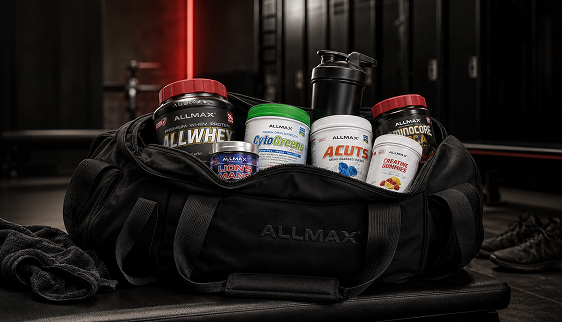
Whole foods should form the base of a healthy diet, but supplements can make macro goals easier. Whey isolate or blended whey can add 25–30 g of high-quality protein and amino acids with minimal fats and carbs. ALLMAX Isoflex contains 27 g of protein and is low in carbs and fats, making macro counting easier during cuts.
Creatine monohydrate has essentially no macros or calories and supports strength, power, and muscle size by improving phosphocreatine stores. ALLMAX Creatine fits any bulk or cut.
Most ALLMAX pre-workout options have negligible macros but support energy, pumps, and focus. EAAs and BCAAs may be useful during longer training sessions, particularly when total protein intake or meal timing is less than ideal. Collagen adds protein for connective tissue support, but should complement complete proteins. ALLMAX collagen, greens, and fiber products can support joint, gut, and micronutrient intake without heavily changing macro totals.
Explore ALLMAX Nutrition protein, creatine, pre-workout, and amino acid categories to support your macro-based training plan.
Beyond Macros: Micronutrients, Fiber, and Food Quality
Macro counting can help you lose weight or build muscle, but health also depends on vitamins and minerals, fiber, and food quality.
Choose 70–80% of daily calories from minimally processed nutrition sources, then leave 20–30% for flexible foods if calories and macros fit.
Micronutrients are vitamins and minerals that do not provide calories but support energy production, immunity, bone health, hormones, and the status of essential vitamins.
Eat colorful foods daily: berries, spinach, peppers, broccoli, legumes, fruits, grains, lean meats, eggs, dairy, nuts, and seeds.
Aim for fiber: ~25 g/day for women, ~38 g/day for men, or ~14 g per 1,000 calories.
ALLMAX AllGreens+, Omega-3s, and other wellness products can fill gaps when total calorie intake is low, but they do not replace a balanced diet.
Practical Tips, Common Mistakes, and When to Adjust Your Macros
The biggest mistake beginners make is trying to be perfect. Focus on consistency rather than precision from day one. Tracking within a reasonable range and building sustainable habits is often more effective than obsessing over every gram.
Even the best plan fails without consistency and real-world adjustments.
Pre-log meals the night before.
Repeat easy meals: Greek yogurt + whey, chicken + rice + vegetables, oats + berries + protein powder.
Batch-cook grilled chicken, rice, potatoes, and vegetables.
Do not ignore oils, nut butters, sauces, cream in coffee, or dessert bites.
Check app entries; wrong serving sizes can distort the number of calories and calories per serving.
Reassess every 2–4 weeks using body weight trends, gym performance, recovery, and energy levels.
If weight is not changing, adjust daily calorie intake by ~150–200 calories, usually from carbs or fats.
Start simple: set protein, protect fat minimums, let carbs fill the remaining calories, and track for a few weeks before changing everything. ALLMAX Nutrition supplements can help make tracking macros more convenient while supporting recovery, performance, and muscle mass.